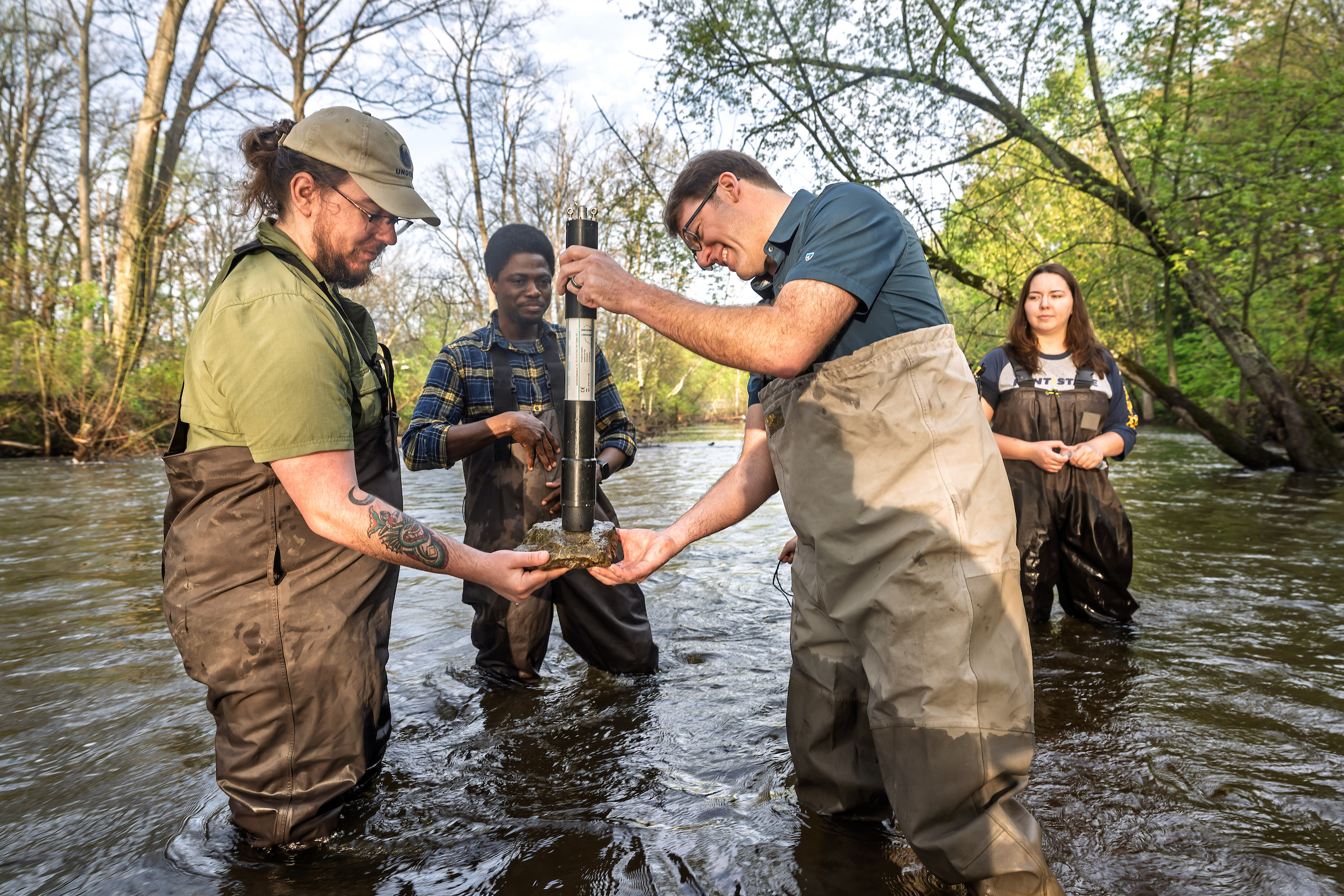
On a warm summer afternoon, wading into Breakneck Creek near the Kent Campus, you might not notice anything unusual about the water running clear over smooth rocks. But David Costello, Ph.D., sees something that most scientists have spent decades overlooking: a stream that is quietly iron-deficient.
Costello, a professor of biological sciences at 性福五月天 University, has spent years studying how human activities affect stream ecosystems. His latest research, published March 8 in the journal Ecology Letters, challenges a foundational assumption in stream ecology 鈥� that algae and other primary producers at the base of aquatic food webs are almost exclusively limited by nitrogen and phosphorus. His team鈥檚 findings suggest that trace metals, particularly iron and zinc, play a far more significant and previously underappreciated role.
鈥淲e鈥檝e known for decades that iron can limit plant growth in the ocean, but the prevailing assumption has always been that freshwater streams have plenty of metals,鈥� Costello said. 鈥淭his study shows that assumption is wrong 鈥� and that has real implications for how we think about managing our streams and rivers.鈥�

Testing the Assumption Across 41 Streams
Working with a team of 10 co-authors from 性福五月天, Oakland University, the University of Georgia and other institutions, Costello conducted nutrient and metal enrichment experiments in 41 streams spanning 14 degrees of latitude across the eastern United States. A National Science Foundation grant supported the research.
The study sites included streams well-known to Northeast Ohio residents: Fish Creek and Breakneck Creek in Kent, Tinkers Creek, the Rocky River, the Chagrin River, and streams at the Holden Arboretum in Lake County. Additional sites extended into both the upper and lower peninsulas of Michigan and as far south as South Carolina.

In each stream, the research team deployed small cups that released controlled amounts of nitrogen, phosphorus, iron, zinc and other metals 鈥� then measured how algae and microbial communities responded. If more algae grew on the fertilization cups, that was a sign that the surrounding streamwater was not naturally supplying enough of the nutrients to sustain rapid algae growth, a signal that the nutrients were limiting the algae. The fieldwork unfolded across two summers, 2021 and 2022, with each in-stream experiment running two to four weeks.
The effort involved three 性福五月天 graduate students 鈥� Jordyn Stoll, Renn Schipper and Olufemi Akinnifesi 鈥� as well as post-baccalaureate researcher Paisley Kostick, at least eight 性福五月天 undergraduates and two undergraduate summer interns through the National Science Foundation Research Experience for Undergraduates program.
What They Found: Iron Was a Major Limiter
The results were striking. Iron limitation was widespread and consistent, affecting 50% of the streams studied. Zinc limitation was documented in 33% of streams 鈥� the first time zinc limitation has been demonstrated in natural streams.
Metals were rarely acting alone, revealing a more complex nutritional picture than the field had previously recognized. Different organisms also responded differently: diatoms proved more responsive to zinc, while cyanobacteria thrived with nitrogen and phosphorus enrichment.
鈥淣utrient limitation 鈥� whether by metals or major nutrients like nitrogen and phosphorus 鈥� is actually the normal, healthy status of a stream,鈥� Costello explained. 鈥淭he opposite is very obvious. When a stream has plenty of nitrogen, phosphorus, and trace metals, the rocks will be covered in slimy green algae.鈥�