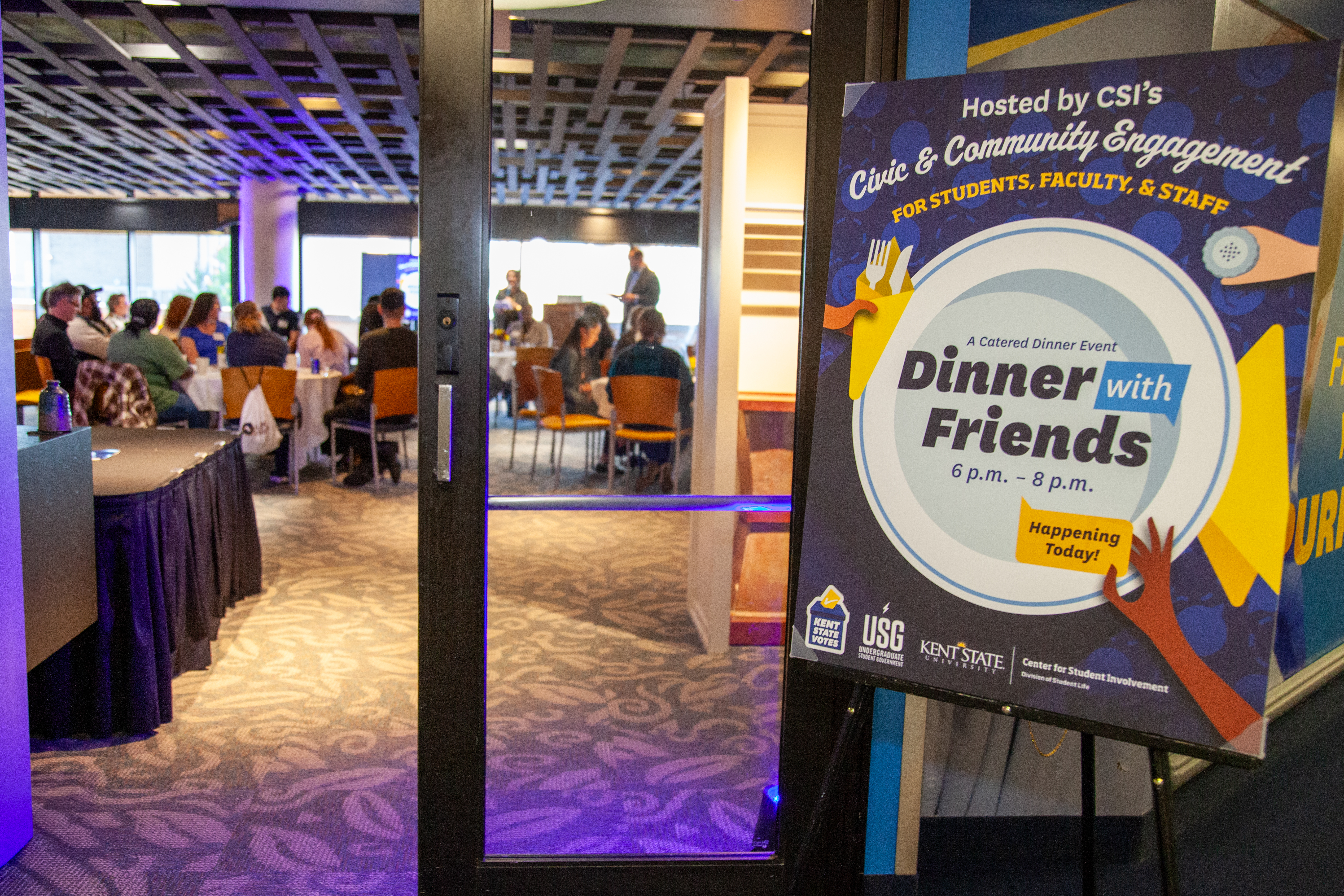
性福五月天's Dinner with Friends returned Thursday, Sept. 24, in the Schwebel Room of the Kent Student Center. Students, faculty and staff shared a meal and talked about issues that matter to the campus community, often with people they would never otherwise meet.
Organized by the Center for Student Involvement, the dinner was the first of multiple sessions planned for the academic year.
Craig Berger, associate director for civic and community engagement in the Center for Student Involvement, said the program grew out of a simple worry.
"Dinner with Friends really started to combat the loneliness epidemic and also build trust in our community," Berger said.
Berger first saw the idea at another institution. In 2021, in the middle of the pandemic, he helped stage a virtual version in which participants brought their own meals to their computers. 性福五月天 20 people took part. He said an in-person version stayed in the back of his mind, and it became a reality in February, when about 50 people filled the Schwebel Room for the first in-person 性福五月天 dinner.
A Place to Connect Outside of Your Role
Berger said the dinners fill a gap for the campus community.
"Students, faculty and staff don't really have a place to connect with each other as human beings outside of their respective roles," he said.

The dinner was built around small, mixed-group conversations led by trained facilitators. The topics were chosen to be approachable, Berger said.
"They don't have to be an expert to do it. These are topics that are really low barrier to entry. It allows them to be able to bring their life experience to the table and then share that with each other," he said.
Conversations centered on mental health, food insecurity, finding community on campus and, new this time, how art shapes life at the university.
Sonia Karkare, coordinator for civic and community engagement in the Center for Student Involvement, said each subject was chosen with care. On food insecurity, she said the issue often goes unspoken.
"It's a silent, hidden problem on campus, and people sometimes are ashamed to talk about the fact that they haven't eaten or don't have access to food," Karkare said.
On art, she said the topic deserves more attention than it usually gets.
"I do believe that art provides a balance that can reduce stress, can help you retain more information, can make you just a happy person," she said.
And on finding community, she pointed to the "You Belong Here" signs around campus.
"Not only do you belong here, you matter here," Karkare said.
Dialogue, Not Debate
Karkare said the format was deliberately gentle.
"This is more about coming together in a safe space, in a space that is put together in a beautiful, loving environment, and you're able to just talk about things that you wouldn't normally talk about," she said.
The goal, she said, was to "begin conversations through dialogue and don't directly go to debate and having acrimonious conversations."
Berger said the mix of guests was intentional, and it can benefit people at every level of the university. Senior leaders, he said, are often focused on charting the direction of a whole division.

"It can be difficult for them to have those in-person student experiences," Berger said.
For students, he said, the experience is just as unusual.
"It's not every day that you get to have dinner with someone with that kind of hierarchical ranking at the university," he said.
Karkare shared one example from the February dinner. An international student was seated with a senior vice president, someone the student "wouldn't normally be able to just go into their office and speak to them."
"But here they were at the table equally, talking to each other, leaving their titles at the door," Karkare said.
Connections That Last
Organizers said the effects reach well past dessert. In a survey of attendees 60 days after the February dinner, 54% said they were still in touch with someone they met that night, and 71% said they were more open in conversations across difference. In the survey taken right after the event, 100% of attendees said they would recommend the program to a friend and reported a greater sense of belonging.
Karkare said that is the point of the program.
"We're building connections. We're building dialogue. We're building a culture of belonging," she said.
Berger said he hopes the lessons travel with participants.
"Remember that we are humans, ultimately, who are just trying to make this place a better place," Berger said. "People are much more than maybe their public persona or your initial impression of them."
"And that lesson not only applies to the university environment, but it's also applicable off campus and could be applicable in the future, wherever they might work or whatever community they might settle in," he said.
How to Join
Register and find more information on the Dinner With Friends page, or follow 性福五月天 Civic and Community Engagement .